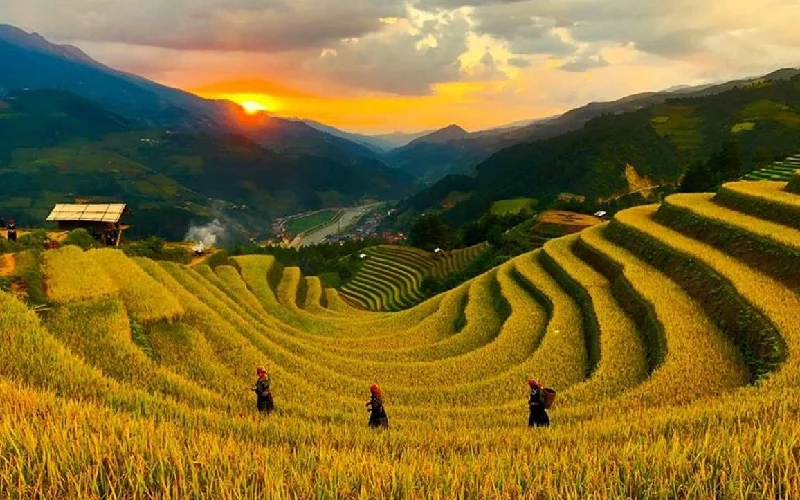
Short version: the terraces around Mu Cang Chai turn gold from mid-August in the Tu Le valley and on the slopes below Khau Pha Pass, and reach their peak at La Pan Tan, Che Cu Nha and De Xu Phinh from mid-September into the first week or two of October. It is 300 km from Hanoi, about six and a half hours door to door in a private car. The sealed highway takes you past every major viewpoint; the hills in the postcards sit above it, up earth tracks that are motorbike ground, not car ground.
Where Mu Cang Chai Is Now
If you are reading older guides, they will place Mu Cang Chai in Yen Bai province. That changed with the 2025 provincial reorganisation: Yen Bai was merged into Lao Cai, and Mu Cang Chai is now administratively part of Lao Cai province. Nothing about the roads, the villages or the terraces changed – but signage, official notices and 2026 event announcements all use the new name, so it is worth knowing which one you are looking at.
Practically, it means Mu Cang Chai and Sapa now sit in the same province. They are still a long mountain drive apart – the best part of a day once you allow for stops – so treat them as two separate destinations rather than a half-day hop.
When the Rice Is Actually Gold in 2026
The harvest does not arrive everywhere at once. It works up the valley in stages, and altitude decides the order.
| Period | What you see | Where |
|---|---|---|
| Mid-August to early September | First fields turning; green and gold mixed | Tu Le valley, lower slopes below Khau Pha Pass |
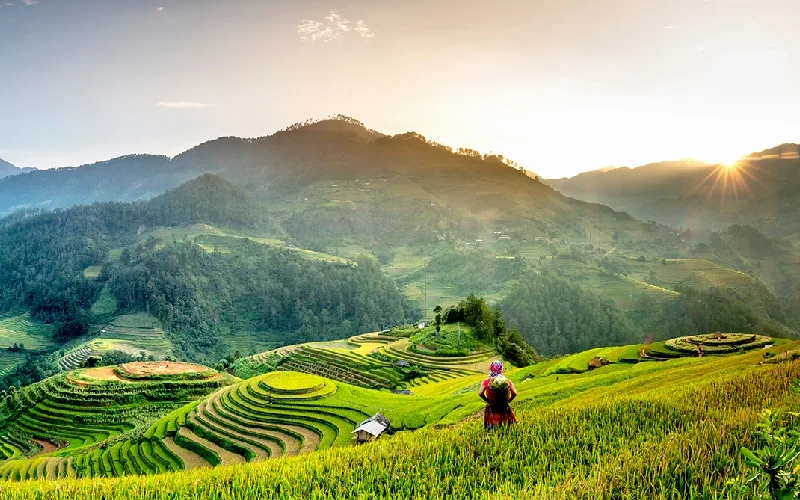
| Mid-September to the first week or two of October | Peak gold, before and during cutting | La Pan Tan, Che Cu Nha, De Xu Phinh |
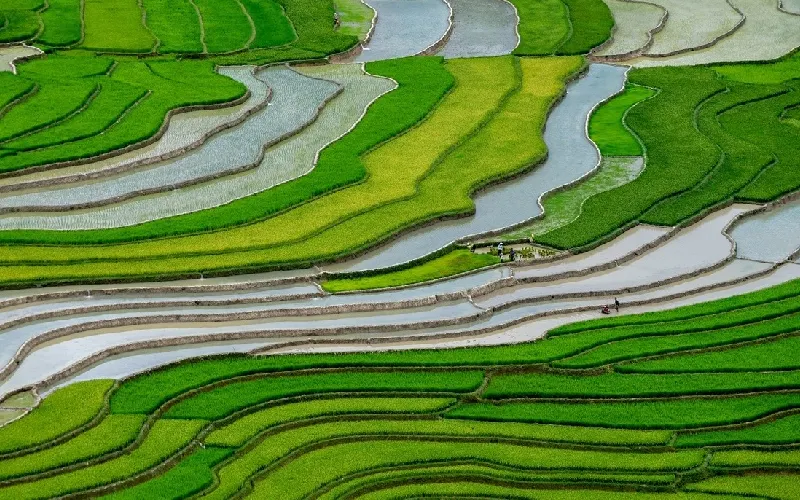
| Late May to June | Flooded terraces, mirror-like at dawn | The same hillsides, water-pouring season |
Harvest timing follows the weather, so a week either side of these windows is normal. Once a village starts cutting, its terraces go from gold to stubble in a matter of days – which is why two neighbouring hillsides can look completely different on the same morning. If you have one weekend and want the best odds, the last ten days of September are the safest bet.
The 2026 Golden-Season Calendar
| Event | Dates | Where |
|---|---|---|
| Tu Le com festival (young green rice) | Opens 22 August 2026 | Tu Le |
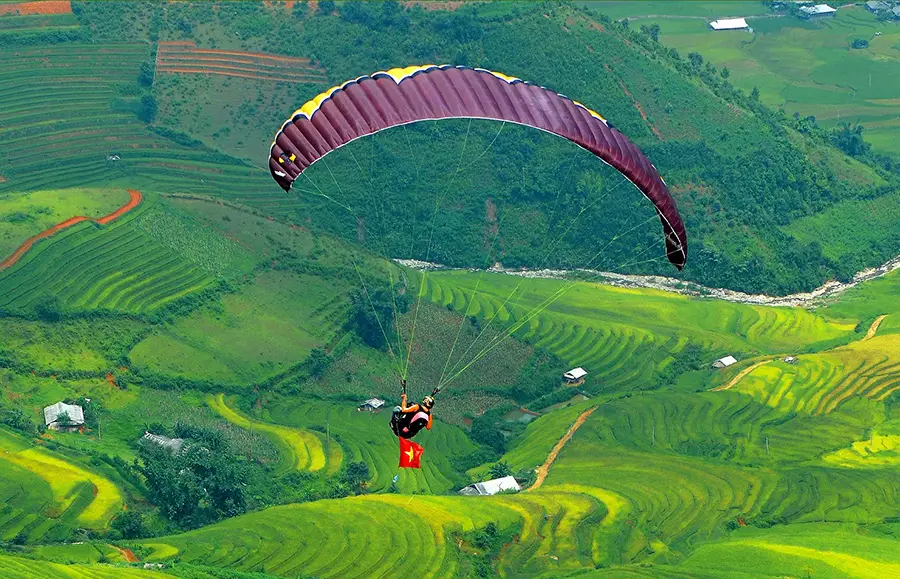
| Paragliding festival “Bay tren mua vang Tu Le” | 30 August to 30 September 2026 | Launch from Khau Pha Pass, landing in the Tu Le valley |
| Mu Cang Chai Ultra Trail | Scheduled 1 to 3 October 2026 | Courses run through the La Pan Tan and Che Cu Nha terraces |
The paragliding festival is the big one. Around a hundred Vietnamese and international pilots fly through the month, and on a clear morning there are canopies over the valley for hours. It is run by the Tu Le commune authorities rather than a tour company, and the flying schedule moves with the wind, so nothing is guaranteed on any given day.
Two things worth planning around. Festival weekends fill the guesthouses in Tu Le and Mu Cang Chai town weeks ahead – book beds before you book the car. And on ultra trail weekends sections of the hill tracks carry runners, so allow extra time for anything on foot.
The Viewpoints, in the Order the Road Reaches Them
Everything below sits on or just off Highway QL32, in the order you meet it driving up from Hanoi.
Tu Le valley. The first properly beautiful stretch, and the place to stop for lunch. Tu Le is known across Vietnam for its sticky rice and for com, the young green rice pounded flat and eaten in early autumn. There are hot springs here too. In August and early September this valley is gold well before the higher villages are.
Khau Pha Pass. Roughly 30 km of Highway QL32, topping out around 1,200 metres, and one of the four mountain passes Vietnamese riders call tu dai dinh deo, the four great passes. The name means something close to “horn of the sky” in Thai. There is a proper viewpoint with space to park near the top, and it is the launch site for the paragliders. On an autumn morning the cloud sits below the road and the terraces appear through it in pieces.
Che Cu Nha. The first of the three heritage villages after the pass, and the quietest of them. The terraces here are steep and tightly stacked.
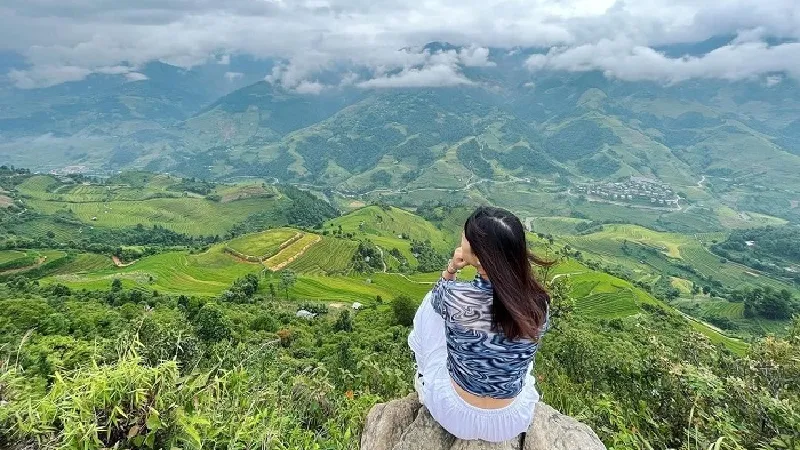
La Pan Tan and Mam Xoi hill. Mam Xoi – “the rice bowl”, often written as Raspberry Hill in English – is the single most photographed hill in northern Vietnam, and it is about 8 km from Mu Cang Chai town, up off the highway. This is the one you have seen.
De Xu Phinh. The third heritage village, above the road on the far side. Fewer visitors, and worth the detour if La Pan Tan is busy.
Mong Ngua hill. “Horseshoe hill”, a couple of kilometres from the town centre – the easiest of the lot to reach, and a good option late in the day when you do not want to climb anything.
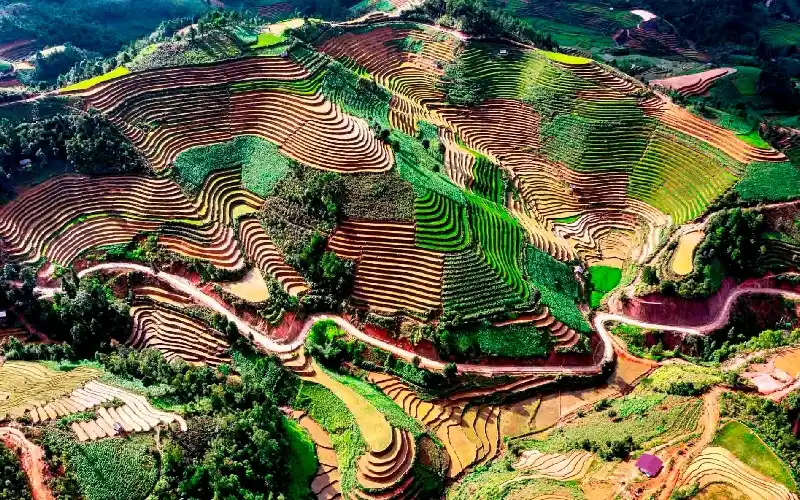
The terraces at La Pan Tan, Che Cu Nha and De Xu Phinh are a recognised national heritage site covering roughly 500 hectares. They are not a park with a gate; they are working farmland that people live on and harvest by hand.
Where the Car Stops, and Where It Cannot Go
This is the part most guides skip, and it changes how you plan the day.
Highway QL32 is sealed the whole way, over Khau Pha and through to Mu Cang Chai town. A car handles it comfortably. The tracks that climb from the highway to Mam Xoi and the hillside hamlets are a different surface entirely: packed earth, narrow, steep, and slippery for a day or two after rain. Cars do not go up them, and no chauffeur worth booking will pretend otherwise.
So the pattern is simple. Your driver parks at the junction on the highway and waits. You go up by xe om – a local motorbike taxi, waiting at every turn-off – for roughly 60,000 to 100,000 VND (≈ $4) for the round trip, or you walk it if you have the legs and an hour to spare. Then you come back down to the car and carry on to the next hill.
There are small charges at the viewpoints, collected by the villages themselves: in the region of 20,000 VND per adult and 10,000 per child, plus a few thousand dong at Mam Xoi for the photo platform and to walk out into the fields. Bring small notes. These amounts change from season to season and are nothing to do with your fare – we do not collect them and we do not mark them up.
How Many Days You Need
Three hundred kilometres each way rules out a day trip. Two days is the minimum that makes sense, and three is the version people come back happy from.
Two days. Leave Hanoi early, lunch in Tu Le, over Khau Pha in the afternoon and into Mu Cang Chai for the last of the light. A full morning and early afternoon on the terraces the next day, then the drive home. It works, but the second day is tight and you will be on the road as the good evening light arrives.
Three days. The same first day, then a full day with nothing in it but hills, villages and lunch, and a relaxed drive back on the third with a stop in Nghia Lo. This is the one to book if the harvest is the reason you came.
Four days. Enough to add Tu Le properly, or to continue rather than double back – Mu Cang Chai to Sapa is a natural onward leg now that both sit in Lao Cai province.
One scheduling note: the best light on the terraces is the first two hours after sunrise and the last hour before sunset. Midday sun flattens them. Plan the driving for the middle of the day and keep the ends of it free.

What a Private Car Costs
Fixed, all-inclusive rates from Hanoi. Fuel, tolls, parking and the chauffeur are all in the number – there is nothing added at the end.
| Vehicle | One way | Return | 2-day package | 3-day package | 4-day package |
|---|---|---|---|---|---|
| SUV, 5 seats (up to 3 guests) | 3,000,000 VND (≈ $115) | 6,000,000 VND (≈ $229) | from 5,000,000 VND (≈ $191) | from 7,500,000 VND (≈ $286) | from 10,000,000 VND (≈ $382) |
| SUV, 7 seats (up to 4 guests) | 3,500,000 VND (≈ $134) | 7,000,000 VND (≈ $267) | from 6,000,000 VND (≈ $229) | from 9,000,000 VND (≈ $344) | from 12,000,000 VND (≈ $458) |
| Executive MPV (4 to 8 guests) | Packages only | Packages only | from 8,000,000 VND (≈ $305) | from 12,000,000 VND (≈ $458) | from 16,000,000 VND (≈ $611) |
Day-trip and multi-day package fares start from these rates and vary with the destination and how far your itinerary goes. Your exact fare is confirmed before you book – no deposit.
The fare is the same starting from Noi Bai Airport as from central Hanoi, which is unusual on northern mountain routes and useful if you are flying in and heading straight up. The Executive MPV – a Kia Carnival or a nine-seat Dcar limousine van – is dispatched to Mu Cang Chai inside multi-day packages rather than as a single transfer, because of the pass.
Payment is at the end of the trip, in Vietnamese dong in cash or by Vietnamese bank transfer. Cards are not accepted. There is no prepayment and no deposit, and you can cancel free of charge up to 24 hours before pick-up. The full route breakdown, including the drive itself and what the fare covers, is on our Hanoi to Mu Cang Chai private car page.
Practical Notes
- Pack a layer. Days are warm in September and October; nights at altitude are properly cool.
- Book beds first. Late-September weekends in Mu Cang Chai town and Tu Le sell out well ahead, festival or not.
- Eat local. Tu Le sticky rice and com, grilled black pork, stream fish and bamboo shoots are what the valley does well.
- Bring cash. Small notes for the viewpoint charges and the xe om; card acceptance up here is thin.
- Expect bends. Khau Pha is 30 km of switchbacks. If anyone in the car is prone to motion sickness, sit them in the front and take something before the climb, not during it.
Book the Drive
One car, one chauffeur, no shared seats and no detours to pick up other passengers. Our chauffeurs speak everyday English on the road, and our support team answers in fluent English on WhatsApp 24 hours a day, including while you are on the mountain.
Message us on WhatsApp at +84 981 911 954 with your dates and the size of your party, and we will confirm the vehicle and the fixed fare in writing before you commit to anything.